
Analyzing Historical Maps and Documents with AI: A Student's Guide
Learn how AI vision tools can help you decode historical maps, primary sources, and archival documents for deeper understanding in history courses.
Try ScreenHelp Free
Get AI-powered screen assistance for any task. Analyze screenshots and get instant guidance.
Get StartedWhy Historical Document Analysis Matters
Whether you're taking AP History, pursuing a humanities degree, or studying for a certification in archival sciences, the ability to read and interpret historical documents is a foundational skill. From faded census records to centuries-old cartographic projections, these primary sources are the raw material of historical understanding.
But let's be honest — staring at a 17th-century map with unfamiliar symbols, archaic handwriting, or a projection system you've never encountered can be genuinely bewildering. This is where AI tools with visual understanding capabilities are becoming surprisingly useful for students and researchers alike.
Types of Historical Materials Students Encounter
History and humanities courses increasingly ask students to engage directly with primary sources rather than relying solely on textbook summaries. Here are some common categories:
Historical Maps
- Political boundary maps showing territorial changes across eras
- Trade route maps illustrating economic networks
- Military campaign maps with troop movements and battle positions
- Exploration charts with early cartographic conventions
- Thematic maps depicting demographic, linguistic, or religious distributions
Written Documents
- Letters and correspondence between historical figures
- Government decrees, treaties, and legislation
- Newspaper clippings from specific historical periods
- Diary entries and personal accounts
- Census data and statistical records
Visual Primary Sources
- Political cartoons and propaganda posters
- Photographs from specific historical events
- Architectural plans and city layouts
- Paintings and illustrations depicting historical scenes
Traditional Approaches to Document Analysis
Before diving into how AI can help, it's worth understanding the established frameworks historians use. These methods remain essential — AI is a supplement, not a replacement for critical thinking.
The SOAPS Method
Many history educators teach the SOAPS framework for analyzing primary sources:
- Speaker — Who created this document?
- Occasion — What event or context prompted it?
- Audience — Who was the intended audience?
- Purpose — Why was it created?
- Subject — What is the main topic?
The OPVL Method
Common in IB History programs, OPVL evaluates:
- Origin — When and where was it produced?
- Purpose — What was the creator's intent?
- Value — What can this source reliably tell us?
- Limitations — What biases or gaps exist?
Map-Specific Analysis
For historical maps, scholars typically examine:
- The projection and orientation (not all maps place north at the top)
- The legend and symbols used
- What's included versus omitted (deliberate absences are revealing)
- The political context of the mapmaker
- Scale and accuracy compared to modern geography
These frameworks give you a structured way to extract meaning. But what happens when you're stuck on a specific element you can't identify?
How AI Vision Tools Help with Historical Analysis
Modern AI models with vision capabilities can process images — including photographs of documents, screenshots of digitized archives, and scanned maps — and provide contextual analysis. Here's where this becomes practical for students:
Identifying Unfamiliar Symbols and Scripts
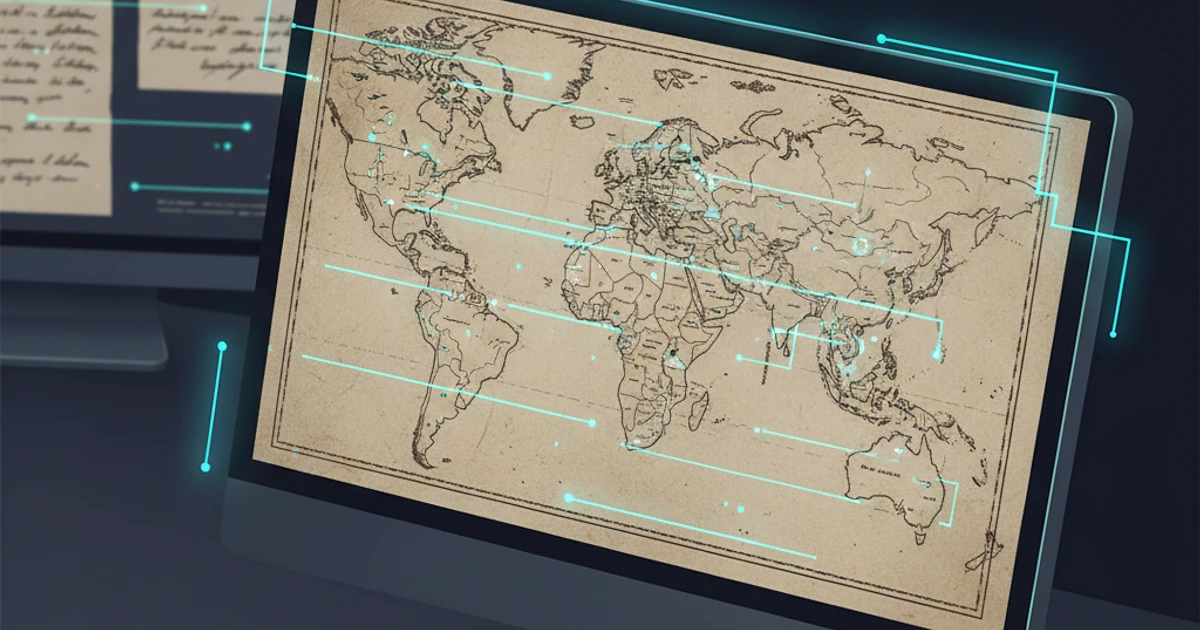
Historical maps are filled with cartographic symbols that have evolved or fallen out of use. An AI that sees your screen can identify these symbols and explain their meaning within the historical context. The same applies to archaic typefaces, abbreviations, and notation systems common in older documents.
Translating and Interpreting Archaic Language
Many primary sources use language that's technically in English (or your study language) but practically unreadable due to archaic vocabulary, spelling conventions, or grammatical structures. AI can help bridge that gap by providing modern interpretations while preserving the intended meaning.
Contextualizing Visual Elements
When you're looking at a political cartoon from the 1800s, the references and caricatures may be completely opaque without deep period knowledge. An on-screen AI assistant can identify likely references, historical figures depicted, and the satirical point being made.
Reading Deteriorated or Handwritten Text
Digitized archival materials often include handwritten documents that are difficult to parse. AI vision models have become increasingly capable at interpreting handwriting styles from various historical periods.
Comparing Map Features to Modern Geography
Older maps often distort geography in ways that reflect the knowledge (or political agenda) of their time. AI can help identify what modern regions correspond to historical territories shown on a map you're studying.
Practical Example: Analyzing a Colonial-Era Map
Let's walk through how you might use an AI screen assistant to study a digitized colonial-era map:
- Pull up the digitized map from your course materials or a digital archive like the Library of Congress or David Rumsey Map Collection
- Identify the basics — date, cartographer, region depicted
- Ask AI about specific elements — unfamiliar place names, symbols in the legend, territorial boundaries you can't identify
- Request contextual information — what was happening politically when this map was made? What does the choice of projection or centering suggest about the mapmaker's perspective?
- Cross-reference the AI's explanations with your course materials and lecture notes
With a tool like ScreenHelp, this process becomes seamless. You share your screen while viewing the document, trigger a prompt, and the AI analyzes what's displayed — whether that's a map in a digital archive, a document in your course PDF, or a source on a museum website. You can even set up custom prompts specifically for document analysis, such as one that always applies the SOAPS framework to whatever's on screen.
Tips for Getting Better Results
When using AI to help analyze historical materials, the quality of your interaction matters:
- Be specific in your questions. Instead of "What is this map?" try "What do the red boundary lines on this 1780s map of the Ohio Valley likely represent?"
- Provide context you already know. Tell the AI what course you're studying, what period you're focused on, and what you've already identified.
- Use it iteratively. Start with broad identification, then drill into specific elements that puzzle you.
- Verify claims. AI can occasionally misidentify historical details. Cross-reference important claims with scholarly sources.
- Save useful explanations. When the AI provides a particularly clear explanation of a concept, save it for your study notes.
Free Digital Archives Worth Exploring
If you want to practice your document analysis skills, these repositories offer extensive collections of digitized primary sources:
- Library of Congress Digital Collections — Millions of digitized items from American history
- Europeana — Cultural heritage materials from across Europe
- David Rumsey Map Collection — Over 100,000 historical maps
- The National Archives (UK) — Documents spanning 1,000 years of British history
- Gallica (Bibliothèque nationale de France) — French historical documents and maps
- World Digital Library (UNESCO) — Primary sources from cultures around the world
These are excellent resources for practice exams, research papers, and deepening your engagement with course material.
Beyond Maps: Other Humanities Applications
The same AI-assisted analysis approach works across the humanities:
- Art History — Analyzing compositional techniques, identifying iconographic elements, and comparing stylistic periods
- Archaeology — Interpreting site maps, stratigraphic diagrams, and artifact photographs
- Philosophy — Working through dense passages from primary philosophical texts displayed on screen
- Religious Studies — Analyzing manuscript illuminations, sacred art, and liturgical documents
- Political Science — Examining historical election maps, legislative documents, and diplomatic correspondence
Building Genuine Understanding
The goal of using AI for historical document analysis isn't to shortcut learning — it's to remove barriers that prevent deeper engagement with the material. When you can quickly decode an unfamiliar symbol on a map, you spend more time thinking about why that symbol matters in its historical context. When archaic language is no longer an obstacle, you can focus on the argument the author was actually making.
Tools like ScreenHelp work well for this because the workflow mirrors how you actually study: you're already looking at the material on your screen. Instead of switching to a separate tab to manually describe what you're seeing, you capture what's on your display and get immediate, contextual analysis. The ability to read responses on your phone via QR code is particularly handy when your screen is occupied by a full-screen archival viewer.
History is ultimately about interpretation, not just information. AI can help you access and understand the raw materials faster, but the critical thinking — connecting sources, questioning perspectives, building arguments — remains yours to develop.
Start Using AI Screen Assistance Today
Join thousands of users who are already working smarter with ScreenHelp.
Related Articles
The Modern Historian: Using AI to Contextualize Primary Sources
Learn how AI tools are transforming the way students and researchers analyze primary sources, from ancient manuscripts to historical photographs.
Read article
Marketing Strategy: Analyzing Ad Creatives with AI Vision
Learn how AI vision tools can help marketers dissect ad creatives, identify winning design patterns, and sharpen competitive analysis in real time.
Read article
Film Studies: Analyzing Scene Composition with AI
Learn how AI vision tools can help you break down cinematography, lighting, and framing in film scenes — turning every pause into a deeper study moment.
Read article