
Homework Help: Understanding Linear Inequalities with AI Vision
Struggling with linear inequalities? Learn how to solve, graph, and interpret them—and discover how AI vision tools can accelerate your math learning.
Try ScreenHelp Free
Get AI-powered screen assistance for any task. Analyze screenshots and get instant guidance.
Get StartedLinear inequalities are one of those algebra topics that trip students up—not because the math is impossibly hard, but because the rules shift just enough from regular equations to cause confusion. If you've ever stared at a homework problem wondering whether to flip the inequality sign or how to shade a number line, you're not alone.
In this guide, we'll break down everything you need to know about linear inequalities, from foundational concepts to common pitfalls, and show how AI-powered screen assistance can help you study more effectively.
What Are Linear Inequalities?
A linear inequality looks a lot like a linear equation, but instead of an equals sign, you'll see one of these symbols:
- < (less than)
- > (greater than)
- ≤ (less than or equal to)
- ≥ (greater than or equal to)
For example:
3x + 5 > 14
Instead of finding the single value of x that makes both sides equal, you're finding a range of values that make the statement true.
Solving Linear Inequalities: Step by Step
The process is nearly identical to solving linear equations, with one critical exception.
Step 1: Isolate the Variable
Treat the inequality like an equation. Use inverse operations to get the variable by itself.
Example: Solve 3x + 5 > 14
- Subtract 5 from both sides:
3x > 9 - Divide both sides by 3:
x > 3
The solution is all real numbers greater than 3.
Step 2: The Sign-Flip Rule
Here's where students lose points: when you multiply or divide both sides by a negative number, you must flip the inequality sign.
Example: Solve -2x + 8 ≤ 14
- Subtract 8 from both sides:
-2x ≤ 6 - Divide both sides by -2 and flip the sign:
x ≥ -3
Why does this happen? Think about it on a number line. If 2 < 5, then multiplying both sides by -1 gives -2 > -5. The order reverses. This isn't an arbitrary rule—it's a consequence of how negative numbers work.
Step 3: Write and Interpret the Solution
Solutions can be expressed in multiple ways:
| Format | Example |
|---|---|
| Inequality notation | x > 3 |
| Interval notation | (3, ∞) |
| Number line | Open circle at 3, arrow pointing right |
| Set-builder notation | {x | x > 3} |
Knowing all four formats matters because different teachers, textbooks, and standardized tests prefer different representations.
Graphing Linear Inequalities on a Number Line
Graphing is where the concept becomes visual:
- Open circle (or parenthesis) for strict inequalities:
<or> - Closed circle (or bracket) for inclusive inequalities:
≤or≥ - Arrow direction shows which values are included in the solution set
For x ≥ -3: draw a filled-in circle at -3 and shade everything to the right.
Graphing Linear Inequalities in Two Variables
Things get more interesting when you move to two variables, such as:
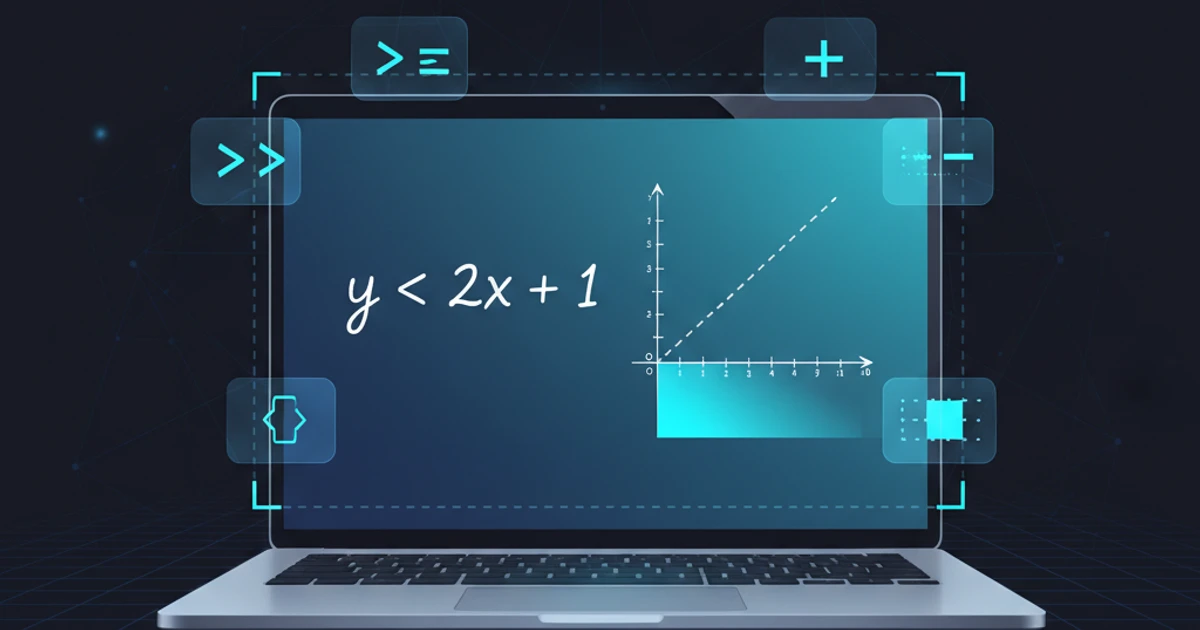
y < 2x + 1
Here's the process:
- Graph the boundary line (
y = 2x + 1). Use a dashed line for<or>and a solid line for≤or≥. - Choose a test point not on the line (the origin
(0, 0)is usually easiest). - Substitute the test point into the inequality. If it's true, shade the side containing that point. If false, shade the opposite side.
The shaded region represents every (x, y) pair that satisfies the inequality—infinitely many solutions.
Compound Inequalities
Compound inequalities combine two conditions:
- "And" (intersection):
2 < x ≤ 7— the variable must satisfy both conditions simultaneously. - "Or" (union):
x < -1 or x > 4— the variable satisfies at least one condition.
"And" inequalities produce a bounded segment on the number line. "Or" inequalities produce two rays pointing in opposite directions.
Common Mistakes to Avoid
- Forgetting to flip the sign when multiplying or dividing by a negative. This is far and away the most common error.
- Using the wrong circle type on number lines (open vs. closed).
- Shading the wrong region when graphing in two variables—always use a test point to verify.
- Confusing "and" with "or" in compound inequalities, which leads to drastically different solution sets.
- Distributing incorrectly before isolating the variable, especially with negative coefficients.
Real-World Applications
Linear inequalities aren't just textbook exercises. They show up everywhere:
- Budgeting: "I can spend no more than $200" translates to
total ≤ 200. - Speed limits: Driving speed must satisfy
0 ≤ v ≤ 65. - Minimum grade requirements: A student needs
average ≥ 70to pass a course. - Manufacturing constraints: A factory must produce at least 500 units but has capacity for at most 1,200.
Understanding inequalities is foundational for linear programming, optimization problems, and many real-world decision-making scenarios you'll encounter in higher-level math and economics courses.
How AI Vision Can Help You Study Linear Inequalities
Even with clear explanations, there are moments when you're stuck on a specific homework problem. Maybe the numbers are messy, the problem has multiple steps, or you're second-guessing whether you flipped the sign correctly.
This is where an AI screen assistant like ScreenHelp can be a powerful study companion. Here's how it works in practice:
- Share your screen showing the problem—whether it's from an online textbook, a PDF worksheet, or a math platform.
- Trigger a capture, and ScreenHelp's AI vision reads the problem directly from your screen.
- Receive a step-by-step explanation streamed back in real time.
Because the AI actually sees your screen, you don't need to retype complex expressions, which is especially useful for inequalities with fractions, absolute values, or systems. You can even set up custom prompts like "Explain each step as if I'm learning this for the first time" or "Check my work and tell me where I went wrong."
For students who prefer working on a tablet or phone alongside their computer, ScreenHelp lets you scan a QR code and stream responses to your mobile device—handy when your main screen is occupied by homework.
Practice Problems
Test your understanding with these exercises:
- Solve:
5x - 3 ≥ 2x + 9 - Solve:
-4(x + 2) < 8 - Graph on a number line:
x ≤ -1 or x > 4 - Graph in the coordinate plane:
y ≥ -x + 3 - Solve the compound inequality:
-5 < 2x + 1 ≤ 11
Quick Answers:
x ≥ 4x > -4- Two regions: solid circle at -1 shading left, open circle at 4 shading right
- Solid line through (0, 3) and (3, 0); shade above the line
-3 < x ≤ 5
If any of these tripped you up, work through them again slowly, paying special attention to the sign-flip rule and circle types.
Tips for Exam Preparation
- Practice the sign-flip rule with deliberate repetition. Create ten problems where you must divide by a negative number, and drill until the flip becomes automatic.
- Draw number lines for every problem, even when the question doesn't ask for one. Visualization builds intuition.
- Use AI tools for instant feedback. Rather than waiting until class to find out you've practiced incorrectly, tools like ScreenHelp can verify your approach on the spot so you don't reinforce mistakes.
- Write out every step. Skipping steps is where errors hide. On exams, showing work also earns partial credit.
Final Thoughts
Linear inequalities are a gateway to more advanced algebra topics like systems of inequalities, absolute value inequalities, and linear programming. Mastering them now pays dividends later. The combination of solid practice, conceptual understanding, and smart study tools—including AI that can see and interpret problems right on your screen—puts you in the best position to succeed.
Start Using AI Screen Assistance Today
Join thousands of users who are already working smarter with ScreenHelp.
Related Articles

Marketing Strategy: Analyzing Ad Creatives with AI Vision
Learn how AI vision tools can help marketers dissect ad creatives, identify winning design patterns, and sharpen competitive analysis in real time.
Read article
Film Studies: Analyzing Scene Composition with AI
Learn how AI vision tools can help you break down cinematography, lighting, and framing in film scenes — turning every pause into a deeper study moment.
Read article
Mastering Statistics: Interpreting Normal Distribution Graphs with AI
Learn how to read and interpret normal distribution curves, understand z-scores, and use AI screen assistance to accelerate your statistics study sessions.
Read article