
Trigonometry Help: Visualizing Unit Circles and Identities
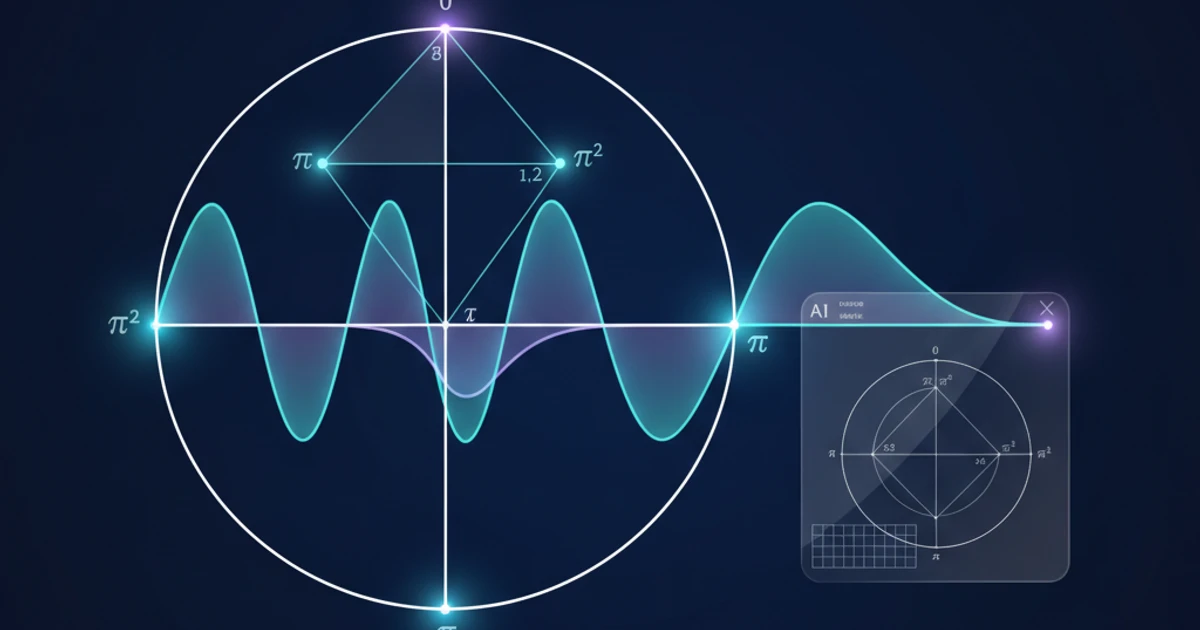
Struggling with trig? Learn how to visualize the unit circle, master key identities, and build real intuition for trigonometry with practical tips and AI tools.
Try ScreenHelp Free
Get AI-powered screen assistance for any task. Analyze screenshots and get instant guidance.
Get StartedTrigonometry is one of those math topics that separates students who memorize from students who truly understand. If you've ever stared at a unit circle diagram and wondered how anyone remembers all those values—or if trig identities feel like an endless list of formulas to cram—you're not alone.
The good news? Once you learn to visualize trigonometry instead of just memorizing it, everything clicks into place. This guide breaks down the unit circle and core identities in a way that builds genuine understanding.
Why the Unit Circle Matters
The unit circle is a circle with a radius of 1, centered at the origin of a coordinate plane. That's it. But this simple shape is the foundation of all trigonometric functions.
Here's the key insight most textbooks bury: every point on the unit circle is just (cos θ, sin θ). The x-coordinate gives you cosine, and the y-coordinate gives you sine. Once you internalize this, you don't need to memorize separate definitions for each function—you just read them off the circle.
Building the Circle Step by Step
Instead of trying to memorize all the standard angles at once, start with the ones you already know:
- 0° (0 radians): The point (1, 0). Cosine is 1, sine is 0.
- 90° (π/2): The point (0, 1). Cosine is 0, sine is 1.
- 180° (π): The point (−1, 0). Cosine is −1, sine is 0.
- 270° (3π/2): The point (0, −1). Cosine is 0, sine is −1.
These four angles divide the circle into quadrants. Now fill in the gaps with the commonly tested angles: 30°, 45°, and 60° (and their equivalents in each quadrant).
The Only Three Values You Actually Need
For the standard angles, sine and cosine only ever take these values:
- 1/2
- √2/2 (approximately 0.707)
- √3/2 (approximately 0.866)
Here's a pattern that helps enormously:
| Angle | sin θ | cos θ |
|---|---|---|
| 0° | 0 | 1 |
| 30° | 1/2 | √3/2 |
| 45° | √2/2 | √2/2 |
| 60° | √3/2 | 1/2 |
| 90° | 1 | 0 |
Notice the symmetry? Sine values go 0, 1/2, √2/2, √3/2, 1 as the angle increases from 0° to 90°. Cosine values are exactly the reverse. This isn't a coincidence—it reflects the complementary relationship: cos θ = sin(90° − θ).
Handling All Four Quadrants
Once you know the first quadrant (0° to 90°), you can derive every other value using the ASTC rule (All Students Take Calculus):
- Quadrant I: All functions positive
- Quadrant II: Only Sine positive
- Quadrant III: Only Tangent positive
- Quadrant IV: Only Cosine positive
So sin(150°) = sin(180° − 30°) = +sin(30°) = 1/2, because sine is positive in Quadrant II. Meanwhile, cos(150°) = −cos(30°) = −√3/2, because cosine is negative there.
Essential Trig Identities (and How to Actually Remember Them)
Trig identities can feel overwhelming, but most of them flow from just a few foundational ideas.
1. The Pythagorean Identity
sin²θ + cos²θ = 1
This comes directly from the unit circle. Since any point on the circle satisfies x² + y² = 1, and x = cos θ, y = sin θ, the identity writes itself.
From this single identity, you can derive two more by dividing through:
- Divide by cos²θ: tan²θ + 1 = sec²θ
- Divide by sin²θ: 1 + cot²θ = csc²θ
That's three identities from one geometric fact.
2. Sum and Difference Formulas
These are the workhorses of trigonometry:
- sin(A ± B) = sin A cos B ± cos A sin B
- cos(A ± B) = cos A cos B ∓ sin A sin B
A helpful mnemonic: in the sine formula, the ± sign matches. In the cosine formula, it flips (∓). The sine formula also "mixes" sine and cosine, while the cosine formula keeps "like with like" then subtracts the "mixed" product.
3. Double Angle Formulas
Just plug A = B into the sum formulas:
- sin 2θ = 2 sin θ cos θ
- cos 2θ = cos²θ − sin²θ
The cosine double angle formula has two useful alternate forms (using sin²θ + cos²θ = 1):
- cos 2θ = 2cos²θ − 1
- cos 2θ = 1 − 2sin²θ
These alternate forms are what you'll see on most exams and certification tests because they simplify more complex expressions.
4. Half-Angle Formulas
Rearranging the double angle formulas gives you:
- sin²(θ/2) = (1 − cos θ)/2
- cos²(θ/2) = (1 + cos θ)/2
These are essential for integration in calculus, so if you're studying for AP Calculus or a university exam, invest time here.
Visualization Techniques That Work
Abstract formulas stick better when you can see them. Here are concrete strategies:
Sketch, Don't Just Read
Every time you encounter a trig problem, draw a quick unit circle. Mark the angle, drop a perpendicular to the x-axis, and label the triangle. This takes 15 seconds and dramatically reduces errors, especially with sign mistakes across quadrants.
Use Your Hand (The Hand Trick)
Hold your left hand in front of you, fingers spread. Assign each finger an angle:
- Thumb: 0°
- Index: 30°
- Middle: 45°
- Ring: 60°
- Pinky: 90°
To find a sine value, lower the finger for that angle and count the fingers below it. Take the square root of that count and divide by 2. For cosine, count the fingers above the lowered finger. It sounds odd, but it works every time.
Connect to Real Graphs
The unit circle and sine/cosine waves are the same information in different formats. As you trace counterclockwise around the circle, the y-coordinate traces out the sine wave. Seeing this animated—or drawing it yourself—builds intuition for amplitude, period, and phase shifts.
Common Pitfalls and How to Avoid Them
Radians vs. degrees confusion. If your calculator is in the wrong mode, everything breaks. Before any computation, check. On exams, circle which mode you're using at the top of your paper.
Forgetting signs in other quadrants. The number one source of "silly mistakes" in trig. Always identify the quadrant before evaluating. Use ASTC.
Misapplying identities. Students often try to use identities in the wrong direction. Ask yourself: "Am I trying to simplify or expand?" Simplifying usually means replacing products with single functions. Expanding usually means applying sum or double angle formulas.
Mixing up inverse functions. sin⁻¹(x) is NOT the same as 1/sin(x). The first is arcsin (the inverse function), and the second is cosecant. This confusion causes more lost points than almost any other trig mistake.
Practice Strategically
Don't just grind through 50 identical problems. Instead:
- Start conceptual: Can you explain why sin(30°) = 1/2 using a right triangle?
- Mix it up: Alternate between evaluating trig functions, simplifying identities, and solving equations.
- Test yourself under pressure: Use timed practice sets that simulate exam conditions. This is where many students discover gaps they didn't know they had.
When you're working through practice problems—especially during timed sessions—having a way to quickly get explanations for steps you don't understand can make a massive difference. Tools like ScreenHelp can act as an AI screen assistant: share your screen, capture the problem you're stuck on, and get a step-by-step explanation streamed back in real time. It's like having a tutor who can see exactly what you're looking at, whether it's a textbook PDF, an online practice quiz, or a graphing tool.
Applying Trig Beyond the Classroom
Understanding trigonometry pays dividends well beyond your current course:
- Physics: Wave motion, oscillations, and vector decomposition all rely on trig.
- Engineering: Signal processing, structural analysis, and electrical circuits use trig identities constantly.
- Computer Science: Computer graphics, game development, and anything involving rotation or periodic functions.
- Certification Exams: Many professional certifications (engineering FE exam, actuarial exams, physics GRE) include trig-heavy sections.
Building visual intuition now means you won't have to re-learn these concepts later.
Quick Reference: Must-Know Identities
Keep this list handy during study sessions:
| Identity | Formula |
|---|---|
| Pythagorean | sin²θ + cos²θ = 1 |
| Tangent form | tan²θ + 1 = sec²θ |
| Double angle (sin) | sin 2θ = 2 sin θ cos θ |
| Double angle (cos) | cos 2θ = cos²θ − sin²θ |
| Sum (sin) | sin(A+B) = sinA cosB + cosA sinB |
| Sum (cos) | cos(A+B) = cosA cosB − sinA sinB |
| Reciprocal | csc θ = 1/sin θ, sec θ = 1/cos θ |
| Quotient | tan θ = sin θ / cos θ |
Final Thoughts
Trigonometry doesn't have to be a wall of memorization. The unit circle is your map, the Pythagorean identity is your compass, and everything else is built on top. Focus on understanding why these relationships exist—through sketching, the hand trick, and connecting the circle to graphs—and you'll find that the formulas start to feel obvious rather than arbitrary.
When you hit a wall during practice, don't just skip the problem—get an explanation, understand the step, and try a similar one. Whether you use a tutor, a study group, or an AI-powered tool that can see your screen and walk you through what you're stuck on, the key is to keep the feedback loop tight and never let confusion pile up.
Start Using AI Screen Assistance Today
Join thousands of users who are already working smarter with ScreenHelp.
Related Articles
Learning Data Structures? Visualize Algorithms with AI
Struggling with data structures and algorithms? Learn how to use visualization techniques and AI-powered tools to finally understand trees, graphs, sorting, and more.
Read article
Visualizing the Nervous System: An AI Anatomy Study Guide
Master the nervous system with visual learning strategies and AI-powered study tools. From neurons to brain anatomy, build lasting understanding for exams.
Read article
Visualizing Timelines: AI Help for History Exams
Struggling to keep historical events straight? Learn proven timeline visualization techniques and discover how AI screen assistants can help you study smarter.
Read article