
Visual Arts: Understanding Color Theory and Composition
Master the fundamentals of color theory and composition in visual arts. Learn about color wheels, harmonies, the rule of thirds, and how to study these concepts effectively.
Try ScreenHelp Free
Get AI-powered screen assistance for any task. Analyze screenshots and get instant guidance.
Get StartedWhether you're studying for an art history exam, preparing for a design certification, or simply trying to deepen your understanding of visual arts, color theory and composition are two pillars you absolutely need to master. These concepts form the foundation of everything from Renaissance paintings to modern UX design.
In this guide, we'll break down both topics into digestible pieces, giving you the knowledge you need to analyze artwork confidently and ace your next assessment.
What Is Color Theory?
Color theory is a framework for understanding how colors interact, how they can be combined, and what emotional or visual effects different combinations produce. It's both a science (rooted in how light works) and an art (rooted in perception and aesthetics).
At its core, color theory helps answer questions like:
- Why do certain colors look harmonious together?
- How can color create mood or direct attention?
- What makes a color palette feel balanced versus chaotic?
The Color Wheel
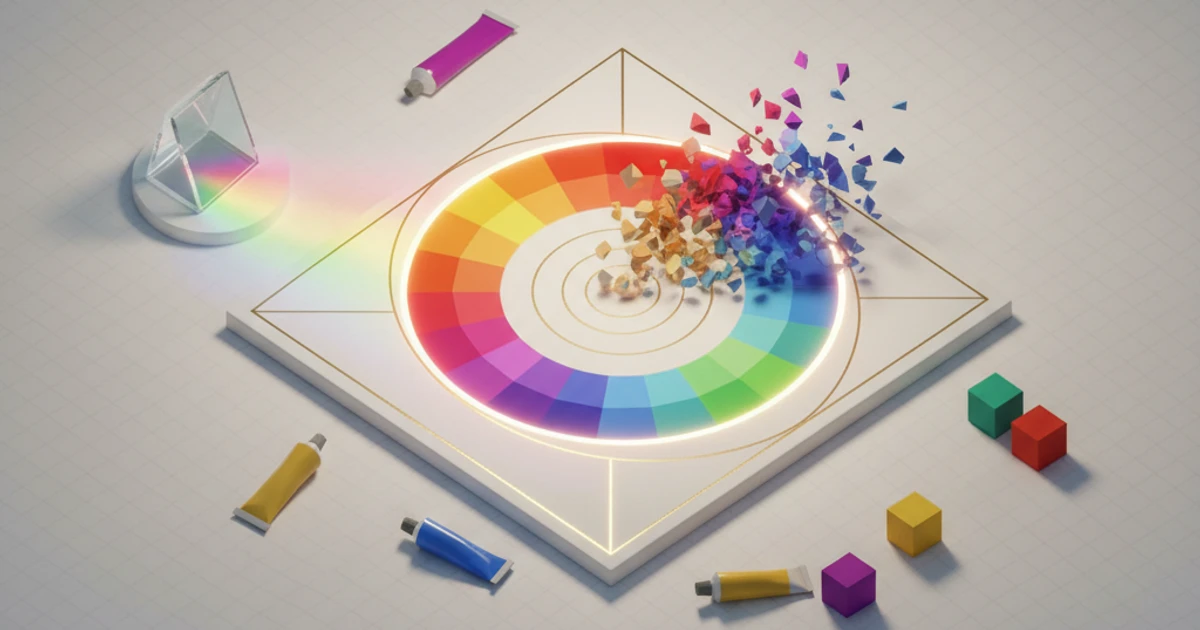
The color wheel, first developed by Sir Isaac Newton in 1666, is the foundational tool of color theory. It organizes colors in a circle to show relationships between them.
Primary Colors: Red, blue, and yellow. These cannot be created by mixing other colors (in traditional pigment-based theory).
Secondary Colors: Green, orange, and purple. Created by mixing two primary colors.
Tertiary Colors: Colors like red-orange or blue-green, created by mixing a primary and an adjacent secondary color.
It's worth noting that there are different color models depending on the medium:
- RYB (Red-Yellow-Blue): Traditional model used in painting and fine art education.
- RGB (Red-Green-Blue): Additive model used in digital screens and lighting.
- CMYK (Cyan-Magenta-Yellow-Key/Black): Subtractive model used in printing.
Understanding which model applies in which context is a common exam topic in both art and design courses.
Color Properties: Hue, Saturation, and Value
Every color can be described using three properties:
- Hue: The pure color itself — red, blue, green, etc.
- Saturation (Chroma): How vivid or muted a color is. A highly saturated red is bold; a desaturated red looks grayish.
- Value (Lightness/Brightness): How light or dark a color is. Adding white creates a tint; adding black creates a shade; adding gray creates a tone.
These three properties are critical for analyzing artwork. When a professor asks you to describe the palette of a painting, they're usually expecting you to discuss hue, saturation, and value — not just name the colors.
Color Harmonies
Color harmonies are specific combinations of colors on the wheel that tend to be visually pleasing. These are among the most frequently tested concepts in visual arts courses:
- Complementary: Colors directly opposite each other (e.g., red and green). High contrast, vibrant when used together.
- Analogous: Colors adjacent on the wheel (e.g., blue, blue-green, green). Harmonious and serene.
- Triadic: Three colors equally spaced on the wheel (e.g., red, yellow, blue). Vibrant and balanced.
- Split-Complementary: A color plus the two colors adjacent to its complement. Strong contrast but less tension than complementary.
- Tetradic (Double Complementary): Four colors forming a rectangle on the wheel. Rich palette, but harder to balance.
- Monochromatic: Variations in value and saturation of a single hue. Cohesive and elegant.
Color Temperature
Colors are often described as warm (reds, oranges, yellows) or cool (blues, greens, purples). Temperature affects the perceived mood and spatial depth of an image:
- Warm colors tend to advance visually (they appear closer).
- Cool colors tend to recede (they appear farther away).
This principle has been used by painters for centuries to create the illusion of depth. Think of how distant mountains in landscape paintings always shift toward blue — that's atmospheric perspective combined with color temperature.
Color Psychology
While somewhat subjective and culturally dependent, certain color associations are widely recognized:
| Color | Common Associations |
|---|---|
| Red | Passion, urgency, danger, love |
| Blue | Calm, trust, sadness, professionalism |
| Yellow | Optimism, attention, caution |
| Green | Nature, growth, prosperity, envy |
| Purple | Royalty, mystery, creativity |
| Orange | Energy, warmth, enthusiasm |
| Black | Elegance, power, mourning |
| White | Purity, simplicity, emptiness |
Be aware that these associations vary significantly across cultures — white symbolizes mourning in some Eastern cultures, while it represents purity in many Western traditions.
Understanding Composition
If color theory governs what you see, composition governs how you see it. Composition is the arrangement of visual elements within a frame, and it determines how a viewer's eye moves through an artwork.
The Rule of Thirds
Perhaps the most well-known compositional guideline, the rule of thirds divides the frame into a 3×3 grid. Placing key elements along the grid lines or at their intersections tends to create more dynamic and visually interesting compositions than centering everything.
While it's a guideline rather than a hard rule, understanding when and why to break it is just as important as following it.
Balance
Balance refers to the visual weight distribution in a composition:
- Symmetrical balance: Equal weight on both sides of a central axis. Feels formal, stable, and orderly.
- Asymmetrical balance: Unequal elements that still feel balanced through differences in color, size, or placement. Feels dynamic and interesting.
- Radial balance: Elements radiate from a central point (think mandala patterns). Creates focus and movement.
Leading Lines
Lines within a composition guide the viewer's eye toward a focal point. They can be literal (roads, rivers, architectural lines) or implied (a row of objects, a person's gaze direction). Diagonal lines add dynamism; horizontal lines suggest calm; vertical lines imply strength.
The Golden Ratio
The golden ratio (approximately 1:1.618) appears throughout nature and has been used in art and architecture for millennia. The related golden spiral creates a naturally pleasing compositional framework. While closely related to the rule of thirds, the golden ratio is mathematically distinct and can produce subtly different results.
Focal Point and Visual Hierarchy
Every effective composition has a clear focal point — the area where the viewer's eye is drawn first. Artists create focal points through:
- Contrast: The area of highest contrast draws the eye.
- Isolation: A single element separated from a group stands out.
- Convergence: Lines or shapes pointing toward the subject.
- Color: A warm or saturated color amid muted tones commands attention.
Visual hierarchy then guides the eye from the primary focal point through secondary and tertiary elements in a deliberate order.
Negative Space
Also called white space, negative space is the empty area around and between subjects. Far from being "nothing," negative space is an active compositional element. It provides visual breathing room, defines shapes, and can itself create recognizable forms (the famous FedEx arrow is a classic example).
How Color Theory and Composition Work Together
These two concepts aren't separate silos — they interact constantly. Consider:
- A warm-colored subject on a cool background uses both color temperature and contrast to establish a focal point.
- A monochromatic palette with symmetrical composition creates a sense of quiet formality.
- Complementary colors placed at rule-of-thirds intersections create maximum visual impact.
When analyzing artwork in a class or exam setting, the strongest answers address both color and composition together, explaining how they reinforce (or intentionally contradict) each other.
Tips for Studying Color Theory and Composition
These subjects are inherently visual, which means studying them requires a different approach than memorizing dates or formulas.
1. Analyze Real Artwork
Don't just read about complementary colors — find examples in Monet, Matisse, or Rothko. Look at how Vermeer used leading lines and how Caravaggio used chiaroscuro (extreme contrast between light and dark) as a compositional tool.
2. Practice Active Looking
When you're studying a painting or design, ask yourself: Where does my eye go first? Why? What colors dominate? What's the balance like? Training this critical eye is essential.
3. Use AI Tools to Get Instant Explanations
When you're reviewing artwork on your screen — whether it's for a class assignment or practice quiz — tools like ScreenHelp can be genuinely useful. ScreenHelp is an AI screen assistant that can see what's on your screen and provide explanations. If you're looking at a painting and want to understand its color harmony or compositional structure, you can trigger ScreenHelp to analyze what you're viewing and explain the principles at work. It's like having a tutor who can look at the same image you're studying and walk you through it.
4. Create Swatches and Sketches
Physically mixing colors or creating composition thumbnail sketches builds understanding in a way that reading alone cannot. Even rough sketches applying the rule of thirds or testing analogous palettes solidify the concepts.
5. Use Flashcards for Terminology
While the concepts are visual, exams often require precise terminology. Create flashcards for key terms — chiaroscuro, complementary, tertiary, asymmetrical balance, golden ratio — and pair each term with an example image.
Common Exam Mistakes to Avoid
- Confusing RGB and RYB: Know which color model applies to the context.
- Calling everything "complementary": If the colors aren't directly opposite on the wheel, they're not complementary.
- Ignoring value: Two different hues can have the same value, which reduces contrast. Many students overlook this.
- Describing composition without explaining effect: Don't just say a painting uses the rule of thirds — explain why that placement creates tension, balance, or focus.
- Treating rules as absolute: The best artists break compositional rules intentionally. Showing you understand both the rule and the reason for breaking it demonstrates deeper knowledge.
Wrapping Up
Color theory and composition are foundational to virtually every visual discipline — fine art, graphic design, photography, film, UX design, and architecture. Whether you're preparing for an AP Art History exam, a design school entrance test, or a professional certification, a strong grasp of these principles will serve you well.
The key is to move beyond memorization and develop the ability to see these principles at work in real images. Study actively, analyze frequently, and don't hesitate to use tools that can help you understand what you're looking at — whether that's your textbook, your instructor, or an AI assistant that can break down the painting on your screen in real time.
Start Using AI Screen Assistance Today
Join thousands of users who are already working smarter with ScreenHelp.
Related Articles

Visual Learning for Board Exams: How to Cram Effectively
Master board exam prep with proven visual learning strategies. Learn how to cram effectively using active recall, visual aids, and AI-powered screen tools.
Read article
Visualizing the Nervous System: An AI Anatomy Study Guide
Master the nervous system with visual learning strategies and AI-powered study tools. From neurons to brain anatomy, build lasting understanding for exams.
Read article
SWOT Analysis on Autopilot: Visualizing Business Case Studies with AI
Learn how to master SWOT analysis for business case studies using AI-powered screen assistance. Break down strengths, weaknesses, opportunities, and threats faster.
Read article